
Passive mobilisation is defined as the action of moving one of a person’s limbs (e.g. arm or leg), without the person participating by contracting their muscles. The manoeuvre has a direct impact on the connective tissues (tendons, ligaments, capsule) of the joint being worked on and on the muscles attached to it.
Mobilisations are the main manoeuvres in physiotherapy. There are several of them, which are grouped in three main categories: analytical, specific and passive mobilizations. It is the last ones that interest us here, since they are not only used by kinesitherapists, but they are also easily integrated into massage therapy.
The effect of passive mobilisation is gentle and deep, yet precise. Moreover, the manoeuvre can be adapted to the person’s health condition, needs and the mobility of the joint being worked on.
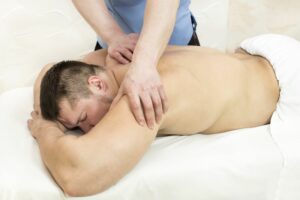
Since they have a direct action on the joints, passive mobilisations have many benefits, for example
The application of passive mobilizations is generally safe, both in the context of a kinesitherapy session and a massage therapy treatment. However, the technique should be avoided in certain situations: